Exodus 3: Holy Ground

“The messenger of the Living God appeared in a fiery flame from the midst of the bramble bush. Moses looked and the bush was burning with fire, but the bush was not consumed.” (Exodus 3:2)
Perhaps what Moses discovers in Exodus 3 is the divine possibility of the present moment. He is making his way through what would have been an ordinary landscape for him when, all of a sudden, he sees this incredible burning bush. He is not on a spiritual retreat or pilgrimage, hoping to hear a word from God. Moses has not made preparations for such an encounter. He is tending the sheep of his father-in-law, just doing his job, when he encounters the Holy. Moses has already learned, on his own, to pay attention to what is not right around him. And now, God comes on the scene.
The story begins in an ordinary way, but the ordinary becomes extraordinary when God’s messenger appears in a fiery flame from the midst of the bramble bush in verse 2. Astonished, Moses says to himself, “I must turn aside and see what in the world is going on here.” The Hebrew word behind the verbal phrase “turn aside” means to change direction or to deviate. Moses sees a strange sight – a bush is on fire, but the fire is not destroying it – and makes the decision not to continue on his way. He could not go on as if nothing had happened. Moses deviates from normalcy and ordinary time to seek God’s hidden figure.
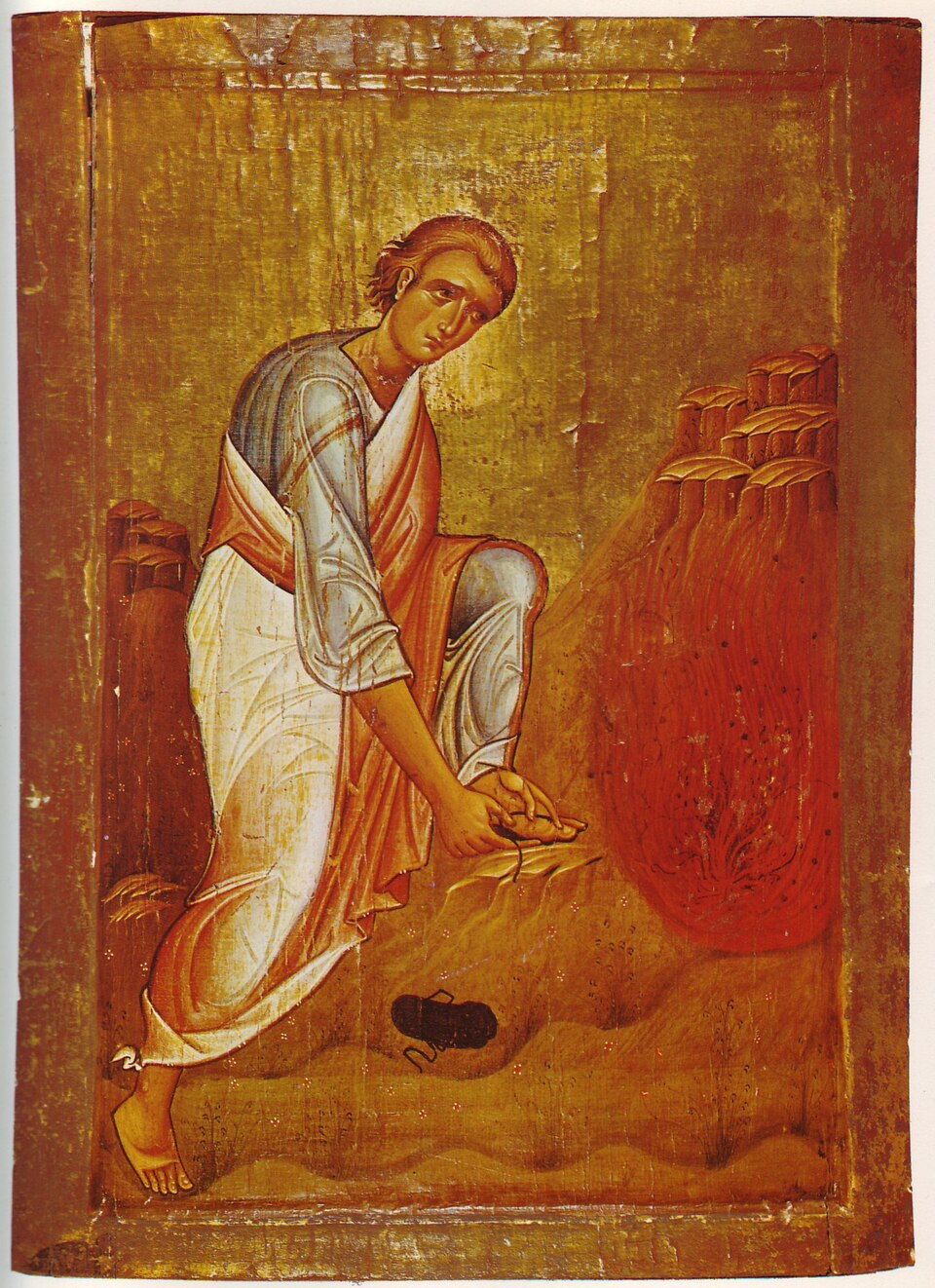
What would have happened if Moses had not turned aside that day? What if he had been distracted by all of his sheep or so troubled by everything that had happened to him recently that he did not notice the bush burning in the distance? What if he noticed but just kept walking? What if he thought to himself, “I’ve got way too much going on right now. Pharaoh wants to kill me, I’m a fugitive, and in the meantime, I’ve got to take care of all these sheep. There are way more important things going on right now. I don’t have time to go on some wild goose chase.” Moses has legitimate and numerous reasons to be preoccupied with his responsibilities and obligations.
Moses did not do any of those “what ifs.'' He stops, turns aside, and takes a closer look. Only when Moses turns aside in Exodus 3:4 does God call out to him. He doesn’t hear from God until he makes the choice to stop. He must take time to come into the present moment in order to hear from the Holy. In verse 5, God says, “Moses, do not come any closer. Take off your sandals. Because the ground on which you are standing is holy ground.” Biblical scholar Terence Fretheim points out,
“Moses’ encounter with God takes place far removed from the sights and sounds of the religious community. There is no temple nearby where he might expect a divine appearance, no sign that this is a holy place…. Yet it would not be the last time that God appeared to shepherds in the wilderness with an announcement of peace and goodwill. And it would not be the last time that God chose a nontraditional, nonreligious setting for a hearing for the word. ”
Fretheim, Terence E. Exodus: Interpretation: A Bible Commentary for Teaching and Preaching (Louisville: Westminster John Knox Press, 1991), 53-54.
Holy ground is sometimes in the least expected places. It certainly is not limited to religious buildings or spiritual spaces. If we are open, we can find holy ground in non-traditional ways and places.
We learned this lesson anew during the COVID-19 pandemic. Many church buildings closed for months, and the religious spaces we counted on as sacred were no longer safe or accessible. As time passed, we began to discover holy ground all around us. Some people found holy ground on their daily walks through the neighborhood or by spending more time outside at local parks. Others baked bread for others as a spiritual discipline, sat down with their immediate families more often for meals, and met some of their neighbors for the first time. We saw the holy ground of our hospitals as healthcare and other frontline workers continued to show up and care for our communities amid an anxious time. When the world began to shut down and our daily activities came to a sudden halt, COVID forced some of us to turn aside and be more present to God in the world and the people around us. The question is, will we continue this practice in a post-COVID world?
**This essay is a slightly revised version of pages 43-44 in Hard and Holy Work: A Lenten Journey through the Book of Exodus, which I co-wrote with Mary Alice Birdwhistell.

A Benediction (Or Miscellaneous Thoughts)
Uncle Ishmael will be exploring the biblical book of Exodus in alignment with the Revised Common Lectionary. The lectionary begins on August 23 with Exodus 1 and concludes its journey through the book on October 11 with Exodus 32.
Here's a list of the Sundays and the Exodus scripture lesson:
August 30 2026 Exodus 3:1-15
September 6 2026 Exodus 12:1-14
September 13 2026 Exodus 14:19-31
September 20 2026 Exodus 16:2-15
September 27 2026 Exodus 17:1-7
October 4 2026 Exodus 20:1-4, 7-9, 12-20
October 11 2026 Exodus 32:1-14


Member discussion