Women Conspiring against Pharaoh

If you are a fan of The Handmaid’s Tale by Margaret Atwood or the television series on Hulu, you know that in the Republic of Gilead, women are stripped of their rights and placed into different categories within this fictionalized society. Each woman wears a different color based on her specific role. For instance, the commanders’ wives wear only shades of blue. The Marthas, the household servants, only wear green. The young girls wear pink. And the Handmaids, assigned to each commander, are known for their signature red dress and white hat.
The Handmaid’s Tale is gut-wrenching to watch because of how women are treated and how they inflict their pain on one another. However, a glimmer of hope arises in season 3, when a group of women – Handmaids, Marthas, and even Commanders’ wives – begin conspiring together against the men ruling over them. As the main character June says, “They never should have given us uniforms if they didn’t want us to become an army.”
When we read the opening two chapters of Exodus, we are reminded of The Handmaid’s Tale in the ways we see powerful women conspiring against Pharaoh, the king of Egypt, who represents the traditional power structure.
In Exodus 1:8-9, this Pharaoh, king of Egypt, is worried about the increasing number of Israelites: “There are more Hebrews than there are Egyptians, and they’re getting stronger than we are. We must do something about this situation.” Yet, his plan to oppress the Israelites and force them into laboring for him does not fare well; in fact, the Israelites continue to increase in number under the excruciating service to the Egyptians. God’s people multiply. Feeling threatened and powerless, Pharaoh devises a nefarious plan and tells two Hebrew midwives – Shiphrah and Puah – to kill any Hebrew baby boys who are born, but the baby girls are allowed to live. It is clear Pharaoh does not consider women or girls to be a threat to his power or empire. But baby boys are another story!
Pharaoh is incredibly mistaken. These women, Shiphrah and Puah (who are surprisingly given names in a text that often leaves marginalized people nameless), do not listen to this unnamed Pharaoh or follow his demands:
“But the midwives feared God; they did not do as the king of Egypt told them. But they let the children live.” (Exodus 1:17)
Shiphrah and Puah strategically play to Pharaoh's bias toward Hebrew women and their fertility, saying, “It’s the most amazing thing, Pharaoh, but the Hebrew women are nothing like the refined Egyptian women you are accustomed to. Hebrew women are like animals. They deliver so quickly, and the baby just plops right out of them before we can even get there to help.” And it seems that Pharaoh believes them.
Shiphrah and Puah have become biblical heroes for how cleverly and courageously they stand up to Pharaoh. As writer Nadia Bolz-Weber said, “Sometimes, the most holy thing we can say is, ‘No – not on my watch.’” (Nadia Bolz-Weber, Shameless: A Case for Not Feeling Bad for Feeling Good (About Sex) (New York: Convergent, 2019), 90.) These truly vulnerable women refuse to follow the king’s villainous scheme and use his fears against him. They realize the absurdity of his lethal request and choose, boldly and faithfully, not to obey the most powerful person in the kingdom. They resist.
When Pharaoh realizes his plan has not worked, he orders that any Hebrew baby boy born must be thrown into the Nile River (Exodus 1:22). If not killed at birth, they would be killed in their infancy. Pharaoh is obsessed with destroying those he sees as inferior. He is a man of death, and he has doubled down on his threat.
Not long after this cruel command, a Hebrew woman, Jochebed, gives birth to a son (Exodus 2:2). But like Shiphrah and Puah, she also says to Pharaoh’s order, “No – not on my watch.” She hides her baby at home for three months to protect him from the deadly fate of the Nile, until she realizes that she cannot keep him a secret much longer. Can you imagine how stressful that time must be for a mother with a newborn? How do you keep a newborn quiet? The Pharaoh of Egypt wants her son, her good baby (2:2), dead. So, in an attempt to save his life, she places her baby in a basket and sends him floating down the Nile River (2:3). Some might ask, “What kind of mother would ever place her baby in a basket or send him into such a dangerous situation?” It is a risky decision indeed, but we might reflect today on parents who take their children across a border and into the United States. The motivation can only be for her child to survive, a mother who is willing to do whatever it takes to save her child’s life.
Did Moses’ mother have a plan? Some biblical scholars wonder if she knows where she is sending the basket – if she knows it will likely float right past Pharaoh’s palace, located further down the river. If she knows this, her actions here are even riskier. For her baby to survive, the right person must find him.
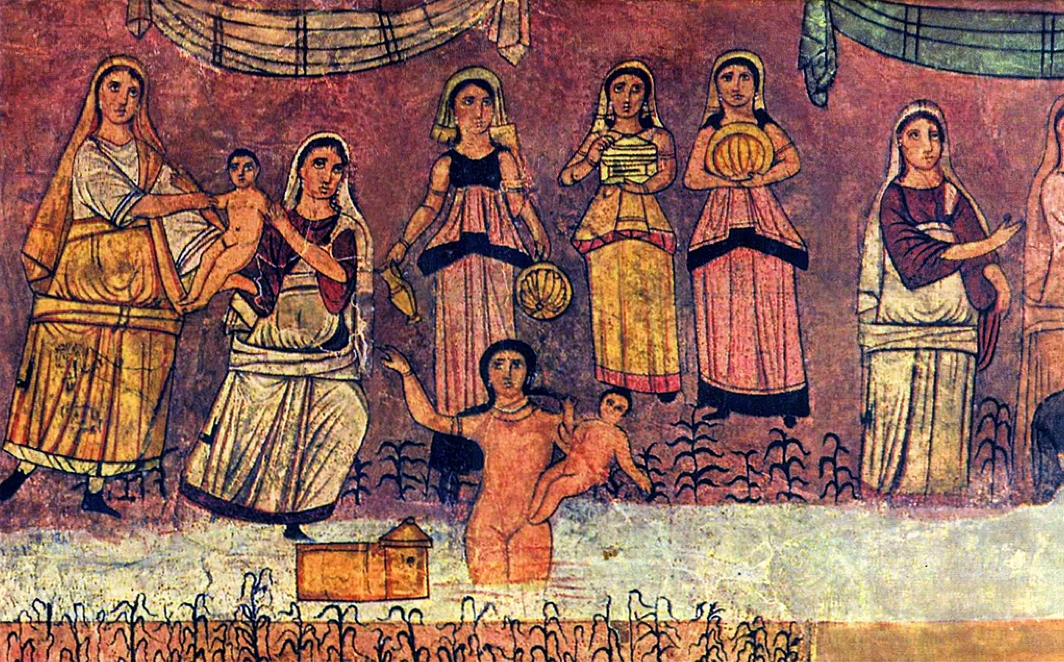
Which is precisely what happens. Pharaoh’s daughter is bathing in the river and comes upon the baby in the basket. She knows immediately the infant must be one of the Hebrew children her father has commanded to be killed.
“The daughter of Pharaoh came down to bathe along the river, while her female attendants walked beside the river. She saw the papyrus basket among the reeds and sent her slave to bring it. She opened it and saw the child. The boy was crying! She had compassion upon him and said, “This one must be from the children of the Hebrews.” (Exodus 2:5-6)
She, too, says, “No – not on my watch,” and begins to wonder what she might do to save this child’s life. But, unlike her father, she shows compassion for the Hebrew baby, disregarding her father’s command.
Meanwhile, another courageous woman watches the rescue unfold. Moses’s big sister – we will later learn her name, Miriam – has been following the basket down the river. When she sees Pharaoh's daughter find him, she must be giddy with excitement. She immediately approaches Pharaoh's daughter saying, “Is that a baby in that basket?! Oh my goodness. How awful! How can I help? What if I could find a Hebrew woman to nurse this child for you? I might know someone who might be willing to do that.” Pharaoh's daughter responds, “Oh yes, absolutely. Great idea! I’ll send wages to the woman who watches after this baby and keeps him safe.” So, in the end, Moses’s own mother is paid by the princess to watch over her own baby, on Pharaoh’s dime no less. The very child who Pharaoh wanted to drown in the Nile is saved from that same river by Pharaoh’s daughter, abetted by a loving mother and a watchful sister.
These women cleverly and intentionally undermine Pharaoh’s power to bring new life into the world. Whereas the mighty Pharaoh is fixated on death, violence, and annihilation, the women harbor life. He commands; they resist. These women notice the injustice around them and act.
Womanist biblical scholar Wil Gafney points out that it is these two women who “become the first deliverers in the book of deliverance.” (Wil Gafney, Womanist Midrash: A Reintroduction To The Women Of The Torah And The Throne (Louisville: Westminster John Knox Press, 2017), 91.) They point us to who God is: A God who is interested in life. A God who delivers us. A God who takes risks on us. A God who wades into the water to come to us. A God who takes notice of us, who is aware and awake. A God who says, “No, not on my watch.”
The hope of the Exodus story comes to life through these women, who notice God’s people suffering in Egypt. Because we have a God who sees us. Even when we as humans don’t pay attention, God sees and teaches us to do the same.
**This essay is a slightly revised version of pages 14-17 in Hard and Holy Work: A Lenten Journey through the Book of Exodus, which I co-wrote with Mary Alice Birdwhistell.
A Benediction (Or Miscellaneous Thoughts)
Uncle Ishmael will be exploring the biblical book of Exodus in alignment with the Revised Common Lectionary. The lectionary begins on August 23 with Exodus 1 and concludes its journey through the book on October 11 with Exodus 32.
Here's a list of the Sundays and the Exodus scripture lesson:
August 23 2026 Exodus 1:8-2:10
August 30 2026 Exodus 3:1-15
September 6 2026 Exodus 12:1-14
September 13 2026 Exodus 14:19-31
September 20 2026 Exodus 16:2-15
September 27 2026 Exodus 17:1-7
October 4 2026 Exodus 20:1-4, 7-9, 12-20
October 11 2026 Exodus 32:1-14



Member discussion